

Welcome to Sunday Supper!
Set the Table
Say your grace
Prayer - Dear God, Thank you for the remnants. Amen.
Affirmation - I don’t discard what is useful.
Gratitude - I am grateful to see the possibility in what remains.
I am grateful for every reader, subscriber, commenter, and those who share this newsletter with others.
The Main Dish
Dig in
Remnants are Enough
Almost fifteen years ago, I got the bright idea to learn to sew. I went to the nearest thrift store in hopes of finding a used sewing machine, and there it was, an old 1970s model, green Singer sewing machine and a small sewing table. I bought both.
I cleaned them, and after months of watching sewing tutorials, I learned to take body measurements, cut patterns and fabric, and operate the sewing machine. Making my first formal dress was the highlight of my first year of sewing.
I became a frequent flyer at one of the local fabric stores, and I always get excited when I find beautiful fabric remnants. These pieces of fabric are what’s left after most shoppers have taken what they need from the fabric bolt. Stores always sell the remnants at a discount.
The remnants may be leftovers, but they still have a purpose. I love the challenge of turning those leftovers into something beautiful.
Unfortunately, over the years, several sewing supply stores have gone out of business. My favorite one closed last spring.
In 2025, over 400 stores of a major sewing supply store chain closed, and many of the remaining sewing stores pivoted to accommodate the influx of new customers. These remaining stores are the remnants of a once-thriving industry.
Remnants extend far beyond fabric and stores.
For example, my mom and dad attended segregated schools, and the books they used were second-hand. They told me that most of the books had scribbles and missing pages. Many were incomplete. Thankfully, their teachers used those book remnants and gave my parents and the other students at Drew Schools a world-class education.
My father-in-law, a cabinet maker, also understands the value of remnants. Leftover wood from his projects doesn’t go to waste. He transforms these scraps into beautiful new pieces of furniture. He has an amazing gift of giving new life to what might otherwise be thrown away.
Even in cuisine, the story of remnants continues. My ancestors took animal and vegetable remnants, parts some would throw away, and turned them into distinctive dishes. Oxtails. Turnips tops. Fish heads.
Over time, working with remnants has taught me a few things. A remnant can spark creativity. A remnant can be revived. There is value in what might get overlooked or discarded. A remnant is worth far more than we can imagine.
Since last year, I’ve been thinking about people as remnants. I often feel like there are just a few people left who love justice, give grace, humility, and kindness. They live by a code, a moral compass. They seem rare. Maybe it’s just me who feels this way.
Will the values of these people get lost in tragedies? Will the ruthless, ruleless ruling class of the United States dim the lights that these remnants carry? Will the remnants hold on to the moral compass that guides them?
It seems as though justice, grace, kindness, compassion, empathy, and humility are outdated in an American culture obsessed with violence and cruelty and driven by greed, accumulation, and division. I used to buy into the idea that sex sells. It does, but I am convinced division is more profitable.
We need the remnants.
Like the fabric pieces, used school books, scraps of wood, or remnants of food, these people can redirect us to a way of living where kindness is the norm, community connects strangers, and justice is tangible. They can help ensure that love takes root, cruelty is challenged, justice has room to grow, and community is built rather than destroyed.
Remnants have always been enough. The question is whether we will recognize their worth before it’s too late.
Pot Likker and Cornbread Crumbs
There’s flavor in the small things.
Welcome the Remnants.
Table Talk
Join the Conversation
What does “Remnants are enough” mean to you?
Potluck
From Our Community Kitchen: Book, Music, Art, Substack
Book

Music
Art
Substack Recommendation
Recipe Exchange
One of my favorite dishes that my mom makes is refrigerator soup. She has a special ability to take all of the scraps in the refrigerator, leftover roast, vegetables, chicken, or anything she can find, and make the most amazing soup.
The soup is what she calls a “stretch” meal. She takes the leftovers to create a new meal. I can’t share the recipe because I never know what will go into the soup, but each time she makes it, I enjoy it. I usually eat cornbread or a peanut butter and jelly sandwich (I know this is unconventional) with her refrigerator soup.
Rather than sharing her refrigerator soup recipe, I am sharing another recipe made from scraps: Chicken Stock.
I use stock for many dishes, and I am happy to share this recipe with you!
Homemade Chicken Stock
Ingredients
1 chicken carcass (bones, leftover skin, cartilage)
1 large onion, quartered (no need to peel perfectly)
2 carrots, roughly chopped
2 celery stalks, roughly chopped
3–4 garlic cloves, smashed
1–2 bay leaves
5–10 whole black peppercorns
Optional herbs: parsley stems, thyme, rosemary
Cold water to cover the bones
Salt to taste (add at the end)
Instructions
Prep the carcass
Remove any large pieces of meat you want for soups or sandwiches.
Break the carcass into smaller pieces if necessary so it fits comfortably in your stock pot.
Combine ingredients in a pot
Place the carcass, vegetables, herbs, and peppercorns in a large stockpot.
Cover with cold water (just enough to submerge the bones).
Simmer gently
Bring to a gentle boil over medium heat, then reduce to a bare simmer.
Skim off any foam or impurities that rise to the top during the first 15–20 minutes.
Cook low and slow
Simmer 3–6 hours uncovered (longer = richer stock).
Add more water if needed to keep bones covered.
Strain the stock
Remove bones, vegetables, and herbs using a slotted spoon.
Pour stock through a fine-mesh strainer or cheesecloth into another pot or container.
Cool and store
Cool to room temperature, then refrigerate (up to 5 days) or freeze (up to 3 months).
If you refrigerate, a layer of fat may solidify on top; you can remove it or stir it in for richness.
Dessert
A Sweet Send-Off
Tired by Langston Hughes
I am so tired of waiting,
Aren't you,
For the world to become good
And beautiful and kind?
Let us take a knife
And cut the world in two -
And see what worms are eating
At the rind.
Reflection today.
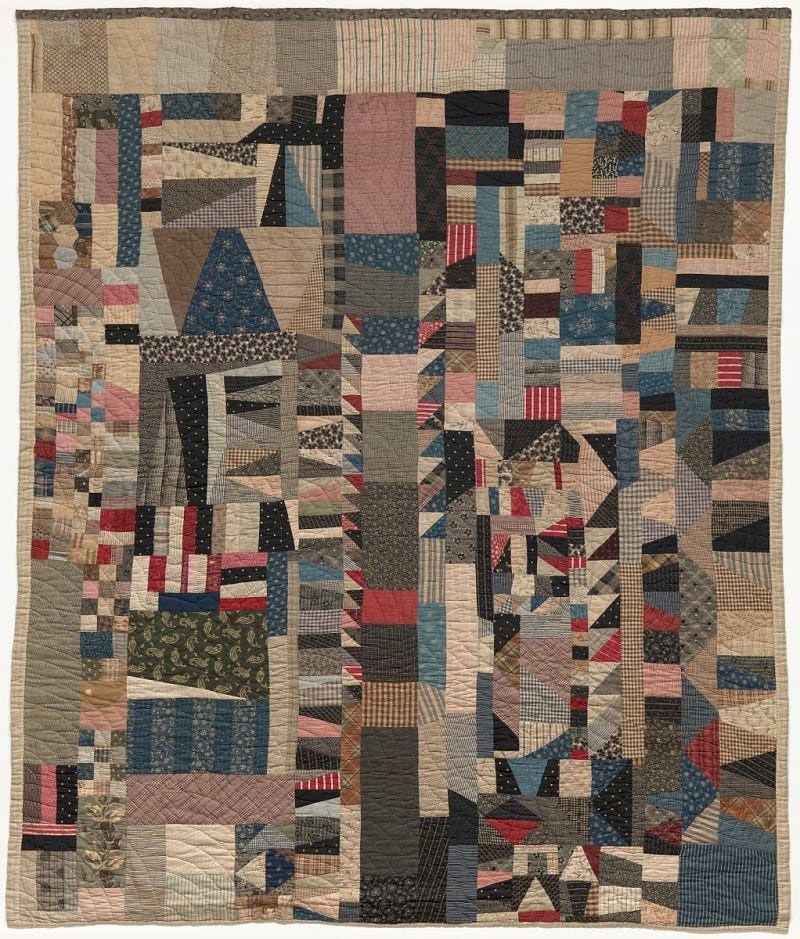
My life is a quilt constructed from remnants. Looked at individually it appears that the remnants are random and have no value, purpose or story. But joining them together as a quilt changes everything. Glad I survived to see the quilt.
I can relate to the fabric remnants. When I first started to sew clothing seriously, I couldn't afford fabric. I scavenged whatever I could find and stitched the pieces together to make a full piece of fabric. Then I kept the remnants from that project and repeated the process until only slivers remained. I'm grateful to be able to afford fabric now and for all the online small retailers offering higher quality fabric than I ever found in person.
What my experience and your post together make me think of is that using remnants is tedious work. It takes longer than using the ideal materials. The outcome might look a bit odd. Some (most?) people would rather complain that they don't have the tools to do anything than do the boring, but creative, work of turning remnants into something useful. Remnants are where artists shine and efficiency devotees struggle.